
We spend heavily on securing our office networks, but the moment we step into an airport lounge or a hotel room, we blindly connect our laptops to networks named “Guest-WiFi.” For any professional living on a roaming profile, jumping from one public connection to another is a massive security blind spot.
When you are working remotely, you cannot control the integrity of the networks around you. A travel router removes that risk entirely by allowing you to bring your own secure, private network wherever you go. For the cost of a nice dinner, it is the cheapest insurance policy you can buy for your data.
What exactly is a Travel Router?
A travel router is essentially a miniaturized version of the Wi-Fi router you have at home, designed to fit in your laptop bag. Instead of plugging it into a modem, you connect it to the public Wi-Fi (like at a hotel or cafe) or plug it directly into a hotel room’s Ethernet jack.
Key Features:
- Single Sign-On for Everything: You connect the travel router to the hotel Wi-Fi and deal with that annoying “Captive Portal” login screen just once. Instantly, your laptop, phone, and tablet are all online because they are securely connected to the travel router’s private network.
- USB Power: Most modern units run off a standard USB-C cable. You can power them directly from your laptop or a portable power bank while sitting in an airport terminal.
- Cellular Tethering: If the public Wi-Fi drops, you can plug your smartphone into the router via USB, and it will seamlessly share your 5G connection with all your devices.
The Hardware Defense: Stopping Attacks in Their Tracks
Software security is great, but physical hardware security is better. Here is how a travel router physically protects you from Man-in-the-Middle (MITM) attacks and local snooping.
1. Network Isolation (The Invisibility Cloak)
When you connect your laptop straight to an airport Wi-Fi network, your device is sitting in the same digital room as hundreds of strangers. A travel router acts as a middleman. You connect the router to the public network, and your devices connect to the router. To a hacker scanning the airport Wi-Fi, your laptop and phone are completely invisible; they only see the router.
2. The Hardware Firewall
Public networks rarely have strict firewalls protecting individual users. A travel router comes with its own built-in hardware firewall. It actively blocks unsolicited inbound traffic from the public network before it ever reaches your laptop.
3. The Built-in VPN Client (The Encrypted Tunnel)
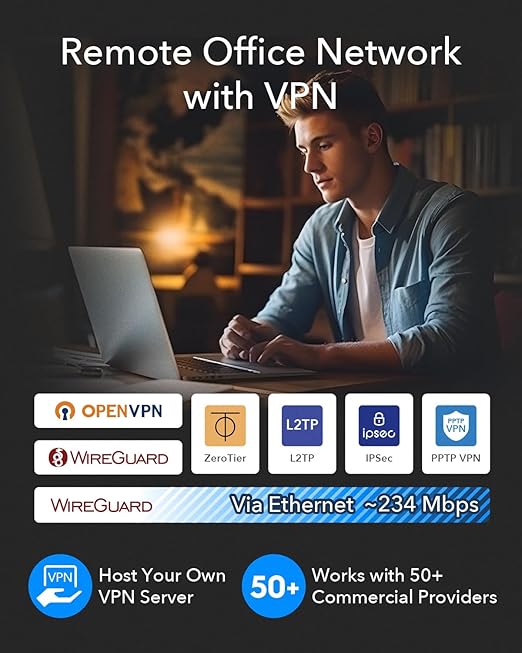
This is the ultimate advantage. Instead of remembering to turn on a VPN app on your phone, and then on your laptop, you configure your VPN account directly onto the travel router. Every single device connected to it is automatically routed through a military-grade encrypted tunnel. Even if a hacker compromises the local Wi-Fi, all they intercept is scrambled, unreadable data.
Top Models and Costs in 2026
The market for these devices has exploded, and the technology has become incredibly affordable. Here are the standout options currently available:
The Budget Friendly: GL.iNet Mango (GL-MT300N-V2)
- Cost: Under ₹5,000
- The Vibe: It is bright yellow, fits in the palm of your hand, and weighs almost nothing. It maxes out at lower speeds and only supports the 2.4GHz band, but for basic email and secure web browsing on a budget, it is a fantastic entry point.
The Sweet Spot: GL.iNet Beryl AX (GL-MT3000)
- Cost: ~ ₹12,000 – ₹13,000
- The Vibe: This is the undisputed champion for most professionals. It supports high-speed Wi-Fi 6, handles modern fiber connections, and has a powerful enough processor to run WireGuard VPNs at incredibly fast speeds without lagging. It is the perfect balance of price, performance, and portability.
The Mid-Range Alternative: TP-Link TL-WR1502X
- Cost: ~ ₹6,000 – ₹8,000
- The Vibe: A highly capable Wi-Fi 6 router that is slightly less feature-dense than the GL.iNet models but offers excellent stability and speeds. Great if you prefer the TP-Link ecosystem.
The Cutting Edge: GL.iNet Beryl 7 (GL-MT3600BE)
- Cost: Premium (Pricing varies by import availability, generally ₹18,000+)
- The Vibe: The newest kid on the block supporting the ultra-fast Wi-Fi 7 standard. If you are handling massive files or doing heavy video conferencing over VPN and want to future-proof your travel kit, this is the top-tier choice.
